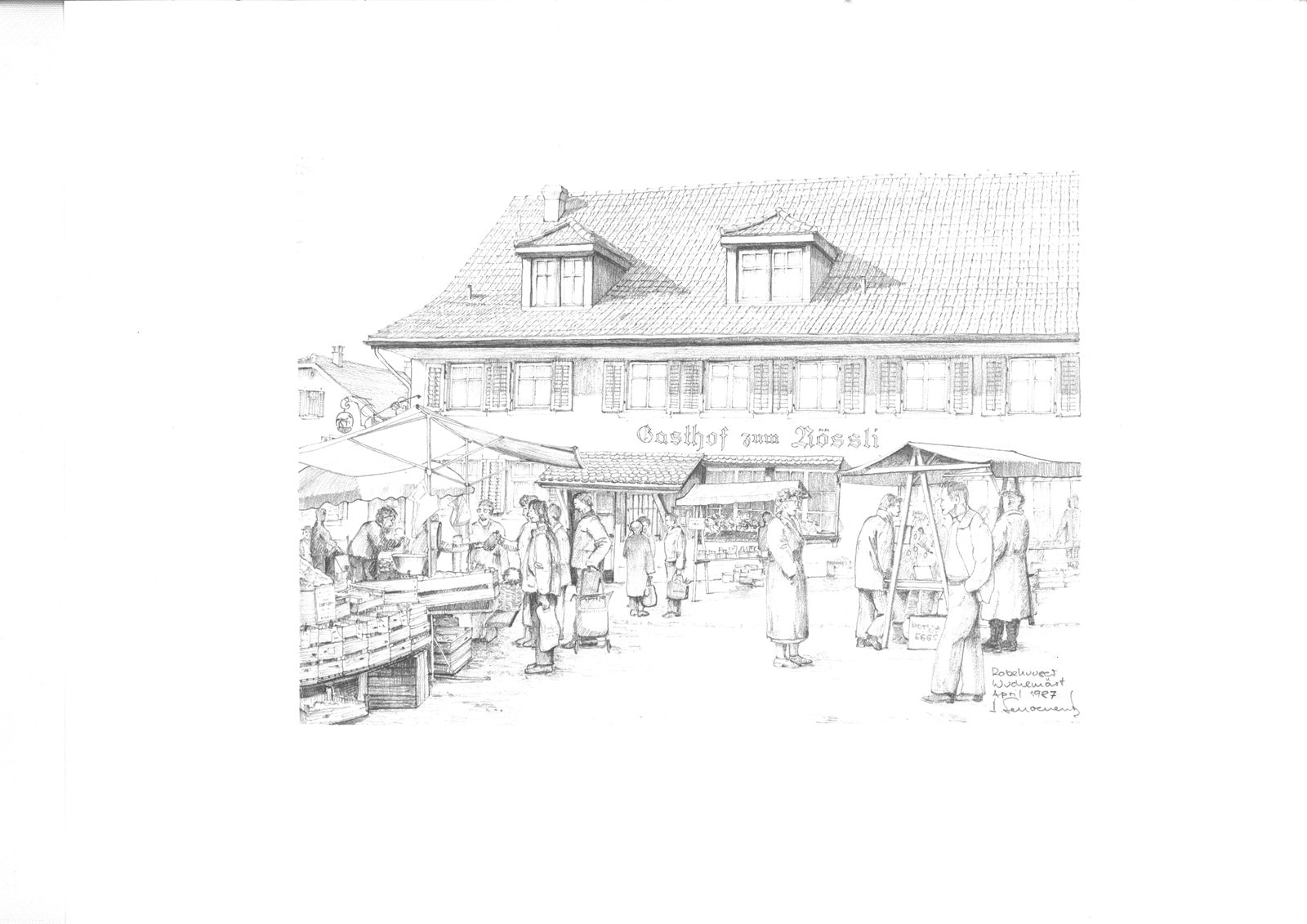
The fen, the houses, the school, the old baths – and since 1976, us.
Robenhausen is one of 111 pile-dwelling sites,
UNESCO World Heritage since 2011.
On Wikipedia: Robenhausen and Wetzikon-Robenhausen.
Plus films from the archive.
Want to know how old Robenhausen is?
Or just take a look at what school used to be like?
LandscapeFen, field names and coat of arms
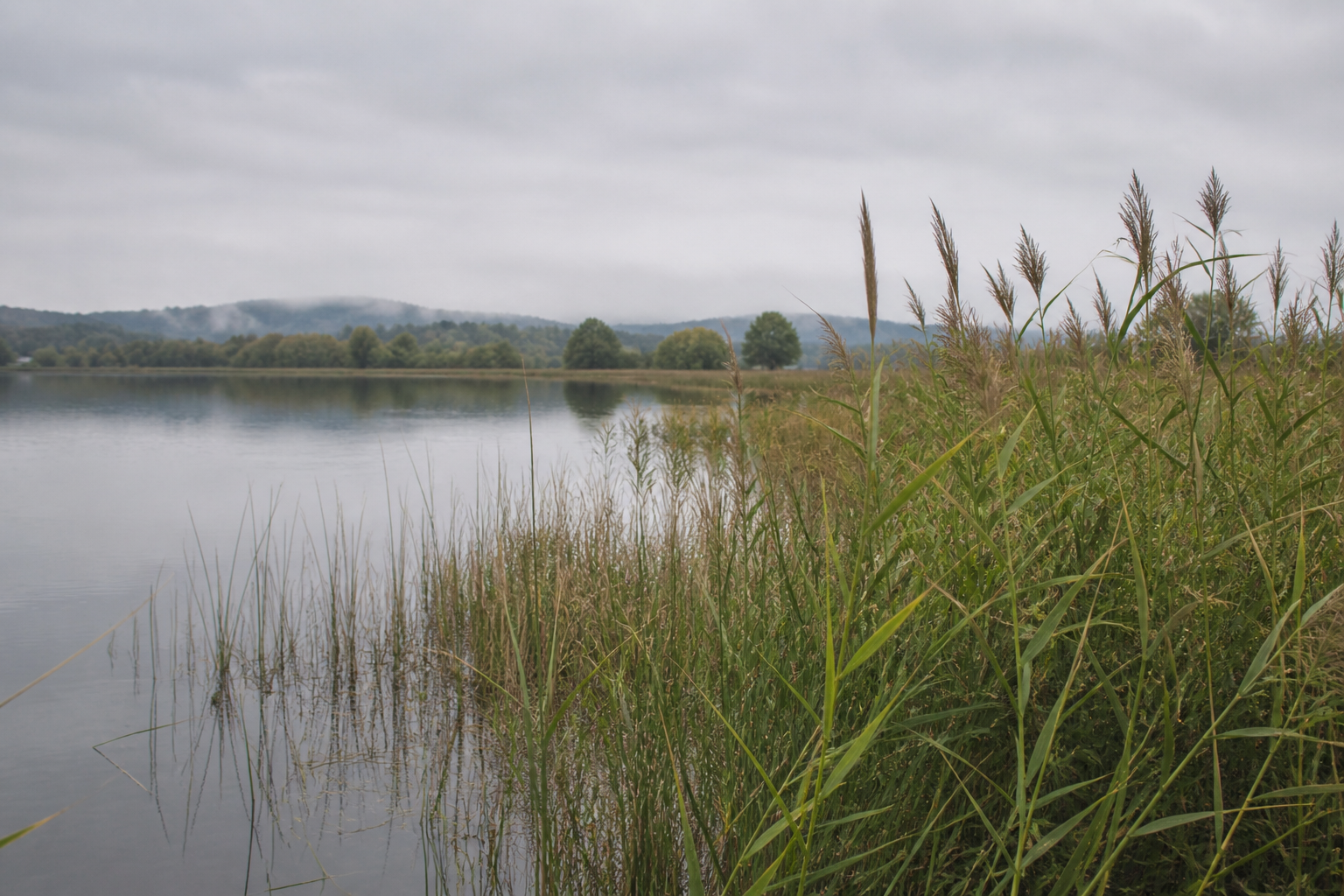
Robenhauser Ried
The moor and lake landscape of Lake Pfäffikersee is one of the most important wetlands of the Swiss Plateau (BLN object no. 5; fen object no. 2212). Lake Pfäffikersee with the silted zone of the Robenhauser Ried lies in a hollow of the Ice Age Linth-Rhine glacier. Low, transitional and raised bogs meet here in a small-scale mosaic.
From the 1950s at the latest a fen developed. Today the area is a typical litter meadow, cut once a year in autumn. Peat was extracted in the Robenhauser Ried roughly between 1740 and 1950.
In 1762 a governmental appeal ruling confirmed: ownership of the fen belongs to Robenhausen, which extracts peat here. Seegräben retains grazing rights. From 1917 to 1921 industrialists such as Gebr. Sulzer, Honegger & Co. and Braschler & Co. took peat from the Hinwil–Wetzikon–Robenhausen area – including from the fields “Himmerich” and “Wildbach-Pfäffikersee-Kemptbach”.
Friedrich von Tschudi already described remains of the aurochs in the pile-dwelling settlements of Robenhausen in 1860. Jakob Messikommer’s discoveries are deliberately omitted here – they can be found on Wetzipedia.
On J. Wild’s map (~1850) among others: Aawiesen, Binzacher, Eichhölzli, Floos/Flos, Hundsgalgen (today a viewpoint with two benches), Krebsgraben, Sandbühl, Schönau, Stägen, Tobelacker, Widum/Wydum, Ziel/Zil. Streets: Dorf-, Halden-, Seegräbner-, Schulhaus-, Stegen-, Uster- and Zürichstrasse.
Siegfried map 1880: Eichhölzliweg, Schönaustrasse, Tobelackerstrasse, today’s Weststrasse. Added in 1930: Binzacker-, Motoren-, Nord-, Tändeli- and Zelglistrasse.
Coat of arms
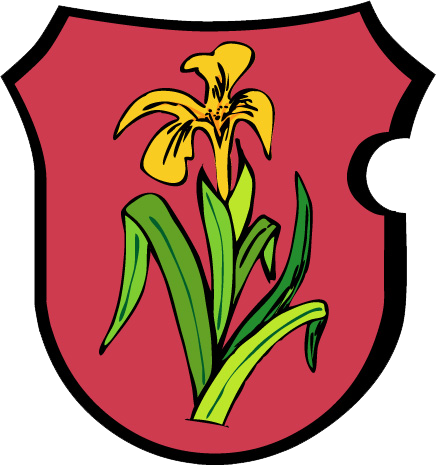
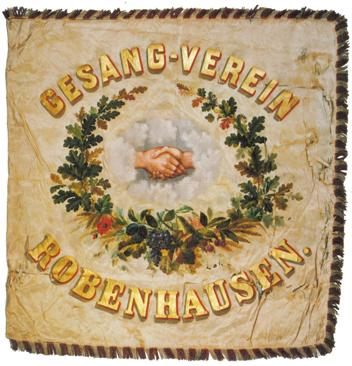
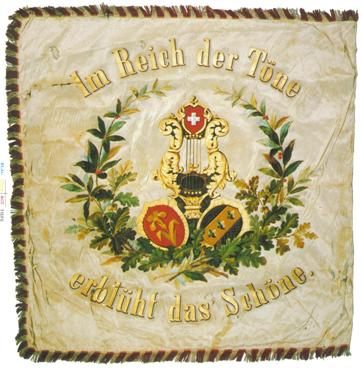
In earlier years Robenhausen is said to have had its own coat of arms, featuring a yellow lily as the main flower of the fen landscape. The Robenhausen choral society had a singers’ banner from the mid-19th century that was neglected and forgotten. In 1955 it was found in the schoolhouse attic. Who designed the coat of arms in use today is still unknown.
Front: Gesang-Verein Robenhausen.Back: “Im Reich der Töne erblüht das Schöne.”
1217–1977From hamlet to town
Cûni Hartman of Rubenhusen
10 May 1446: Hanns Veg, miller of Wetzikon, and Cûni Hartman of Rubenhusen record as authorised representatives that they and the people of Wetzikon, Rubenhusen, Segreben, Ottenhusen, Kempten, Ettenhusen and Medikon were taken into the grace of Duke Albrecht of Austria and of the mayor and council of the city of Zurich, and granted peace for as long as the war between Austria/Zurich and the Confederates lasts.
They and their servants may not be attacked in person or property and may move freely on their land. In return they undertake not to harm Austria and Zurich and not to support the Confederates. Produce may be taken to market in Uznach; iron and salt may be bought.
Source: Zurich State Archives, C IV 1, box 9, folder Wetzikon. Charter abstracts no. 9153.
Municipal boundary of Robenhausen
Napoleon I prescribed the borders of cantons, districts and municipalities for the old Confederation. The formerly independent municipalities of Ober- and Unterwetzikon, Walfershausen, Kempten, Ettenhausen, Medikon-Robank, Stegen and Robenhausen were thereby forced to merge into today’s Wetzikon.
A few key dates
1217
Robenhausen is named as Rubunâ.
1320
Robenhausen is called Rubenhusen for at least 250 years.
1402
Robenhausen belongs to the bailiwick of Greifensee. The lordship of Greifensee is pledged to Zurich. Robenhausen thus becomes the first of today’s Wetzikon districts to join the Swiss Confederation.
1446
Cûni Hartman of Rubenhusen – peace treaty.
1785
Founding of the Robenhausen school. Lessons in the schoolmaster’s parlour.
1798
Napoleon imposes cantonal borders, districts and municipalities on Helvetia. Robenhausen is merged with the other present-day districts into the municipality of Wetzikon.
1799
Compulsory subjects: reading, writing and singing (but not arithmetic!).
1804
Composition of today’s political municipality of Wetzikon. Hans Jakob Hasler (1774–1849) of Robenhausen becomes Wetzikon’s first municipal president, until 1820.
1817
Robenhausen buys a farmhouse and sets up the first schoolroom.
Jakob Messikommer finds a door around 5,000 years old in the Robenhauser Ried.
1895
Decision of the civil board on the first post office.
1898
In the first Swiss motor-car factory in Robenhausen, a car with a petrol engine is built.
1905
Opening of Wetzikon’s first public baths in Robenhausen on the Aa.
1933
Opening of a Konsum branch on Konsumstrasse (today Zelglistrasse 17).
1936
First carnival with a children’s parade – organised by the Freie Radfahrer Wetzikon.
1967
Wetzikon’s first high-rise is built in Buchgrindel.
1972
The Robenhausen school complex at Schulhausstrasse 39 is opened.
1973
First VZO bus connection to Robenhausen.
1976
Founding of Quartierverein Robenhausen.
1977
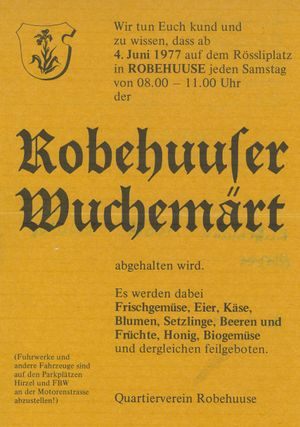
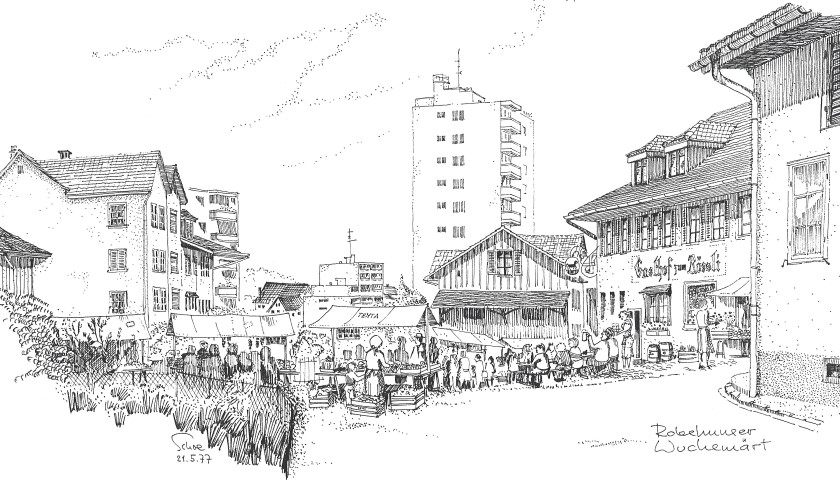
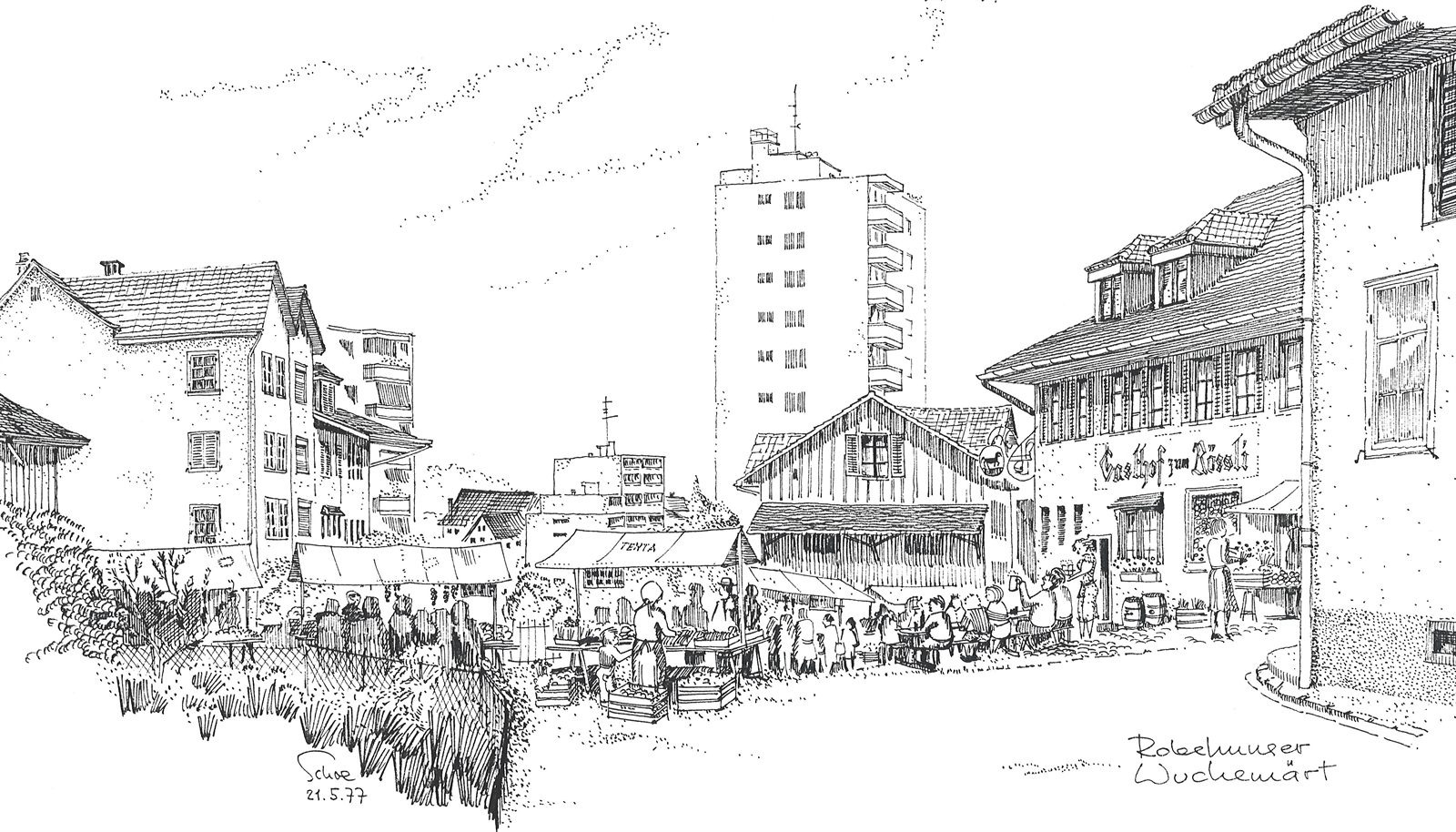
First Robenhausen weekly market on Rössliplatz.
Place & buildingsHouses, mill and fountains
Historic buildings
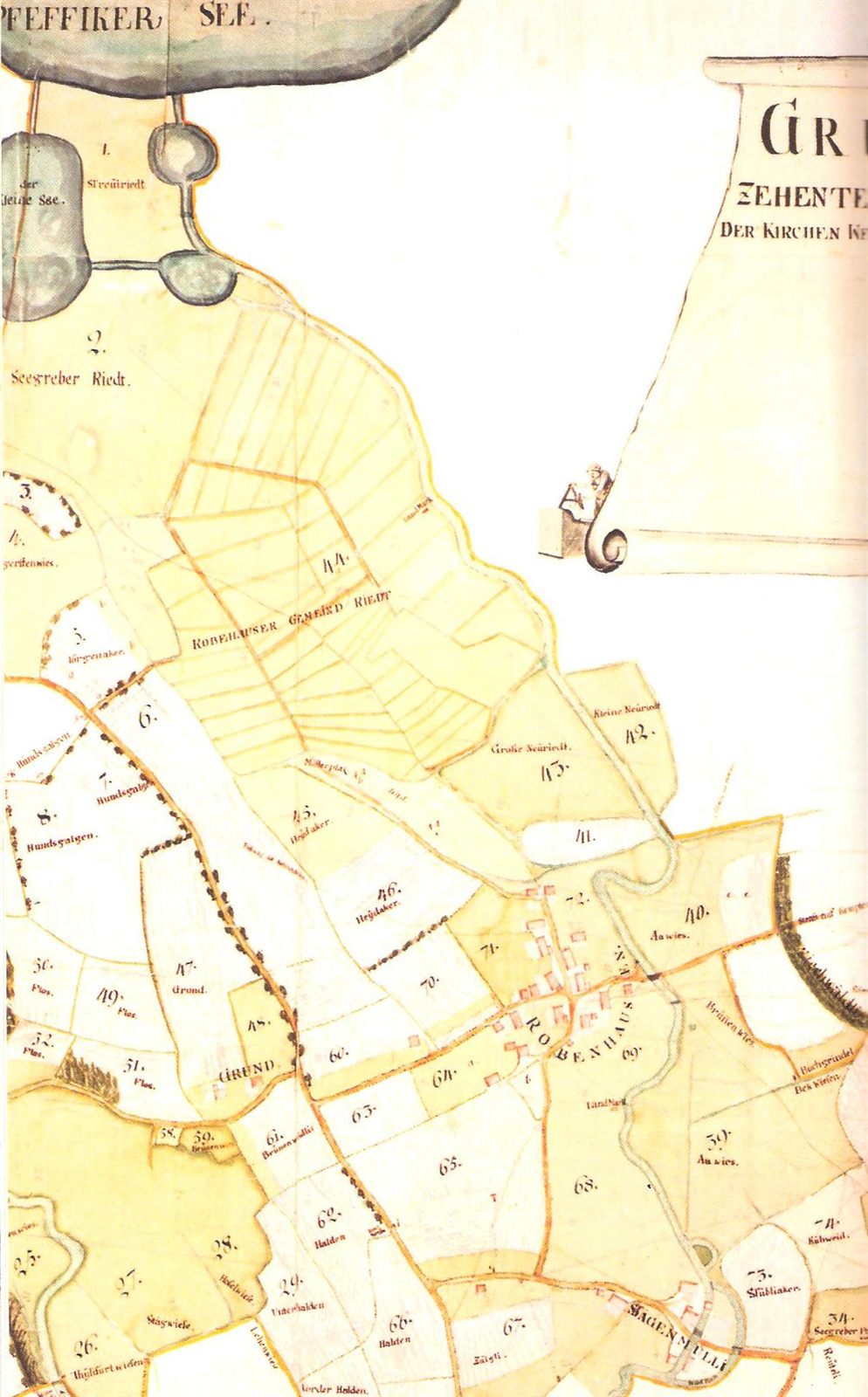
Research by Philippe Caviezel to identify the buildings on the tithe plan of 1698. Sources: Wetzikon land registry, local history archive, Zurich State Archives.
Tithe plan of 1698. From: Beat Frei, Wetzikon – Eine Geschichte, 2002, p. 124.
Buildings still standing include: Restaurant Rössli (Dorfstrasse 23), several Flarz houses on Dorf- and Motorenstrasse, Schulhausstrasse 2–30, Stegen mill (Usterstrasse 88–104). No longer standing: buildings on the site of Motorenstrasse 127 and at Tändelistrasse 5/7 (possibly the former Restaurant Tanne) and Tändelistrasse 8.
House by house
Dorfstrasse
23Restaurant Rössli, built onto Schulhausstrasse 5. Description
24–30House, Flarz
25–31House, Flarz
32House, Flarz, built onto Motorenstrasse 134
34House
35–43House, Flarz
36House, former tinker’s workshop
38–42House
45–53House, Flarz
56–58House, Flarz
59–61House, Flarz
Motorenstrasse
128–134House, Flarz
129–137House, Flarz
Schulhausstrasse
2–4House, Flarz, built onto Dorfstrasse 25
5Former barn, now a house, built onto Dorfstrasse 23
Tändelistrasse 5 or 7one building, perhaps Restaurant Tanne
Tändelistrasse 8two buildings
The mill at Stägen
The Stegen mill often changed hands: 1530 Rudolf Müller, 1615 Jakob Frei, 1630 Hans Heinrich Gujer, 1640 Jakob Burkhard, 1645 Jörg Zindel, 1648 Hans Heinrich Büeler, 1650 Jakob Korrodi, 1660 Hans Wohlgemuth, 1670 Felix Erzinger, 1680 Matthys Wolfensberger (demolished the old mill building in 1691; while it was being raised, the dyer Hans Erhard Moriz fell and died), 1700 Heinrich Zolliker, 1715 Joachim Wuhrmann, 1720 Hans Heinrich Ernst, 1823 Friedrich Nagel (builds the spinning mill in the Schönau with stones from Wetzikon castle tower), 1830 Heinrich Messikommer, 1860 Herr Bidermann – closed the mill and built workers’ housing.
Fountains
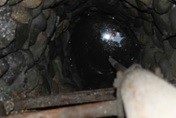
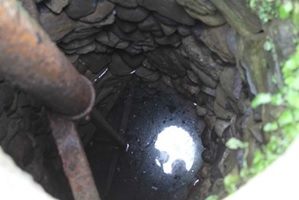
Documentation by Robert Widmer of well and pump fountains:
No. 1 Motorenstrasse 133 – 18th century, Vorderdorf fountain cooperative; shaft still there, post sawn off.
No. 2/3 Dorfstrasse 46 – Hinterdorf; no. 3 from 1870 is still working, the cooperative still active.
No. 7 Grundstrasse 4 – removed in 2017, post rebuilt at Im Zil.
No. 8 Villa im Grund – pump well/cistern for the garden, removed when the Rudolf Steiner School was built.
Looking into a well shaft.Shaft with water.
The Heimatspiegel of 9 September 1987, “Wasser aus tiefen Schächten”, describes the well on Rössliplatz.
Everyday lifeSchool, post office and inns
Robenhausen school
1733 a firm no from the pastor. 1769 provisional permission for Sunday singing and edification hours. 1785 founding, lessons in the parlour. 1815 purchase of a farmhouse (Flarz Motorenstrasse 137) as the first schoolroom. 9 January 1870 inauguration of the first proper schoolhouse at Schulhausstrasse 41. 1890–1893 construction of Schulhausstrasse 37. 2 September 1972 opening of the school complex at Schulhausstrasse 39.
Teachers include: Heinrich Walder (1785), Heinrich Kriesi (1805–1845), Johann Jakob Höhn, Johann Zollinger (1851–1893), David Angst (1893–1933), Albert Kunz (1908–1958).
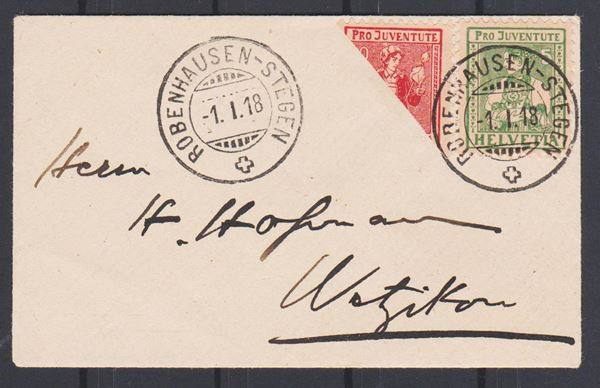
Robenhausen post office
21 May 1895: decision of the civil board. Opened on 1 October 1895 in the Sternen, Dorfstrasse 7. Stamp “Robenhausen-Stegen”. 1910: 46,919 letters posted, 1950: 71,689. From 1963/64 postcode 8621, stamp “Wetzikon 4 Robenhausen”. 1964 moved to a hut on Usterstrasse, 7 July 1971 opened in the business centre at Dorfstrasse 4. From 2010 only postcode 8620. Closed on 7 June 2014 after 119 years. 10 June 2014 post agency at Montanari – this closed in September 2024.
1 January 1918, postmark “Robenhausen-Stegen”.
Konsum Robenhausen
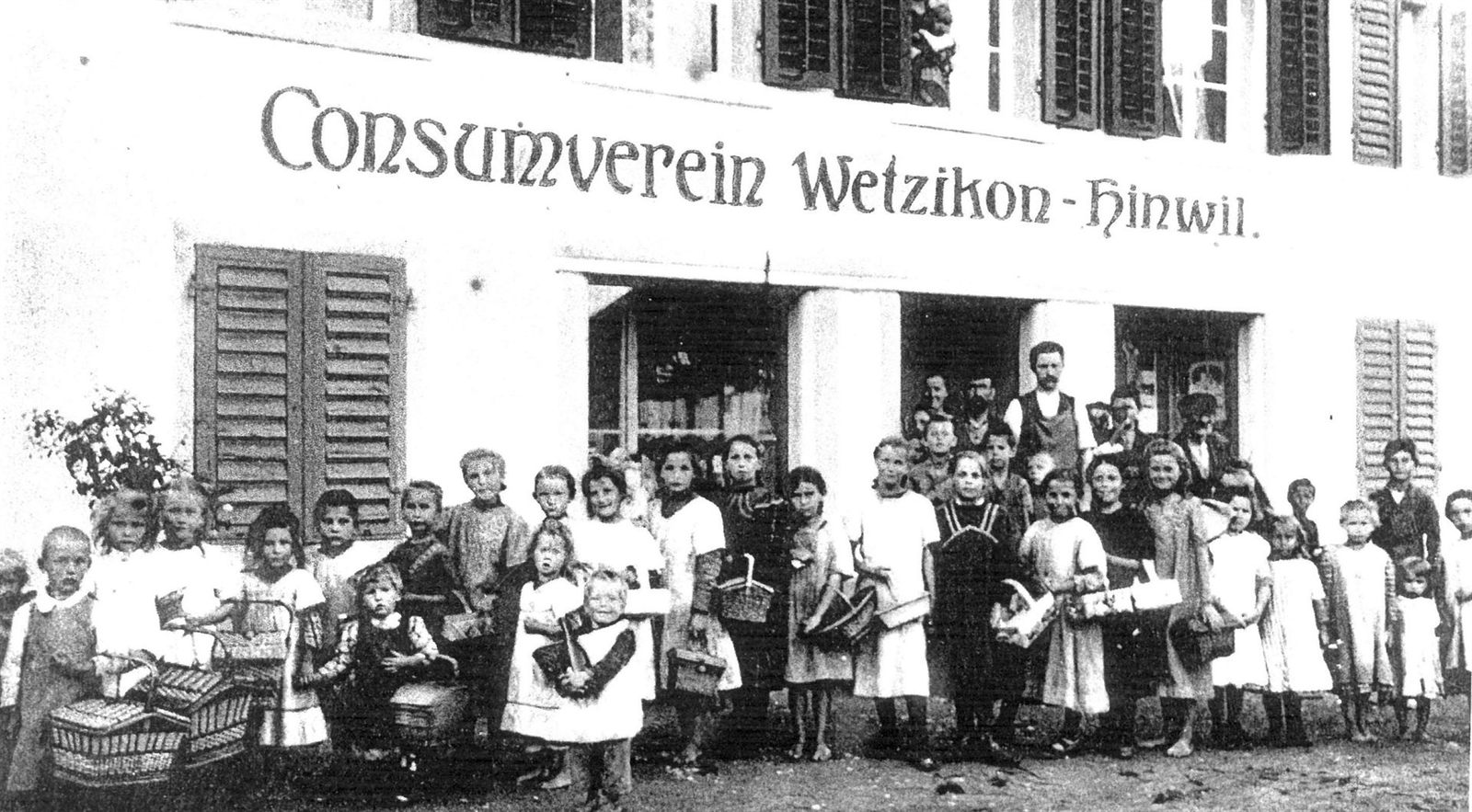
On 24 January 1869 the Wetzikon workers’ association decides on a depot in Stegen. 1899 renamed Arbeiterkonsumverein, 1904 Konsumverein Wetzikon. 1933 opening of the new branch on Konsumstrasse (today Zelglistrasse 17). 1970 merger into Coop Zürichsee/Oberland.
Share certificate of the Consumverein Wetzikon-Hinwil, 1899.
Robenhausen baths
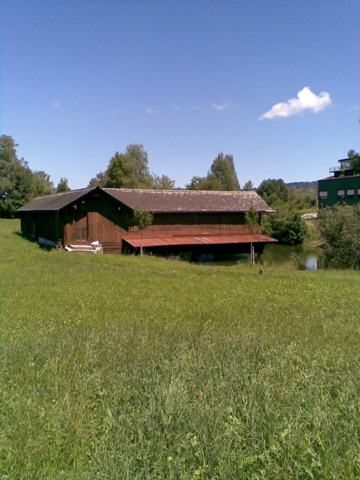
In 1904 architect Johannes Meier designs the baths. In 1905 builder Hirzel and carpenter Dietliker build them for Fr. 13,000. 1906 operation with separate bathing times for men, women, schoolboys and schoolgirls. Bathing ceases in 1952. In 1976 the angling club (from 1980 Aabachgruppe Robenhausen) prevents demolition and renovates the boathouse. Today the Aabachgruppe looks after the old baths. Source: Wetzipedia.
The baths on the Aabach, 2010.
Restaurants around 1900
Anker (Usterstrasse 91), Felsenburg (95), Freihof (130, still there), Grütli (Seegräbnerstrasse 23, demolished 2016), Harmonie (Motorenstrasse 126), Morgenthal (Dorfstrasse 17, Café Montanari since 2006), Rössli (Dorfstrasse 23, still there), Schützenhaus (Motorenstrasse 62), Sonne (Schulhausstrasse 33), Sternen (Dorfstrasse 7, with post office from 1895), Tanne (Tändelistrasse 7), Vergissmeinnicht (Usterstrasse 150), zur Ziegelhütte (Usterstrasse 80 – until 1798 the only restaurant in the area).
As an exclave of the bailiwick of Greifensee, Robenhausen was a long way from the bailiff of Grüningen. From 1728 to 1755 there were complaints that wine and spirit serving was quite unrestrained.
TradesReed blades and cooperage
Heinrich Bertschinger – mechanical reed-blade manufacture
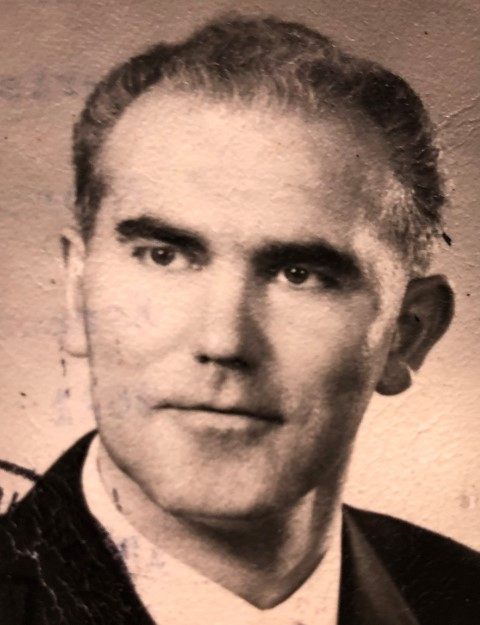
In 1850 Rudolf Egli began making reed blades in Helle-Robenhausen. In 1907 Heinrich Egli-Schneebeli bought a workshop building and ran the business mechanically. In 1930 the business passed to Heinrich Bertschinger (b. 1893 in Lodz, d. 1972 in Wetzikon). Reed blades were made of steel and brass, including for export.
The father Heinrich (b. 1864) had emigrated from the Töss valley to Lodz and built up the weaving-utensils factory there. The son Heinrich (b. 1922) joined in 1955 and sold in 1982 to Karl Egli and Peter Rüegg – later Rüegg + Egli AG, the last reed-blade maker in Switzerland (SRF 22.12.2020). Details from Constanze Schneider, granddaughter.
Heinrich Bertschinger. Details from Constanze Schneider, granddaughter.
Jakob Berli – cooper
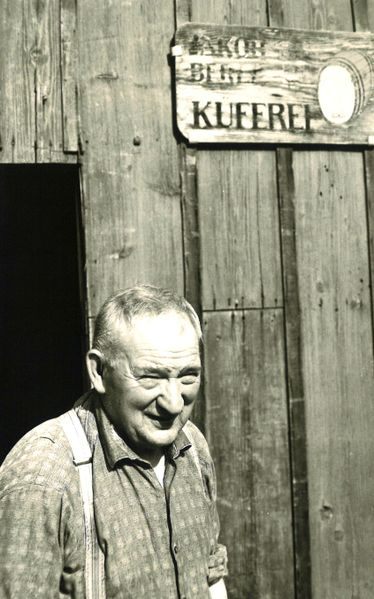
Jakob Berli (b. 22.01.1908, d. 27.06.1988) was a master cooper and ran a cooperage at Dorfstrasse 36 from 1949. After his death the tools went to the “Vereinigung Schweizer Küfer” collection. Film portrait by the KZO, 1973 – see film.
Jakob Berli in front of the cooperage.Workshop, Dorfstrasse 36.
Since 1976Quartierverein Robenhausen
Committees since the founding – presidency, minutes and treasurer.
03.09.1976Founding of the neighbourhood association
04.06.1977First Robenhausen weekly market
1999Market committee becomes a QV department
From 1977 there was an independent market committee. In 1999 it was dissolved and taken over as a department of Quartierverein Robenhausen.
Committees since 1976
Year
President
Secretary
Treasurer
1976
René Scheidegger
Werner Heubi
Silvia Kast
1977
René Scheidegger
Werner Heubi
Silvia Kast
1978
Werner Camenisch
Werner Heubi
Silvia Kast
1979
Werner Camenisch
Werner Heubi
Silvia Kast
1980–1981
René Scheidegger (vice)
Werner Heubi
Silvia Kast
1982–1983
Henri Wolfensberger
Werner Heubi
Katharina Diener
1984–1985
Henri Wolfensberger
Marcel Roten
Katharina Diener / Georg Matter
1986–1988
Hanspeter Bosshard
Marcel Roten
Georg Matter
1989–1991
Hanspeter Bosshard / Gebi Breitenmoser (vice)
Peter Siegenthaler
Georg Matter
1992
Gebi Breitenmoser
Wilma Sigel
Peter Siegenthaler
1993–1997
Gebi Breitenmoser
Annamarie Bocchetti
Peter Siegenthaler
1998–2000
Peter Siegenthaler
Annamarie Bocchetti
Andreas Roten
2001
Peter Siegenthaler
Walter Hauser
Erika Berger
2002–2004
Peter Siegenthaler
Walter Hauser
Willy Friederich
2005–2010
Peter Siegenthaler
Walter Hauser
Peter Leu
2011
Peter Siegenthaler
Sandy Meier
Peter Leu
2012–2017
Peter Siegenthaler
Sandy Meier
Philippe Caviezel
2018
Philippe Caviezel
Peter Fuchs
Laura Frankland
2019
Philippe Caviezel
Martin Müllhaupt
Patricia Fischer
2020–2021
Philippe Caviezel
Eva Schäppi
Patricia Fischer
2022
Philippe Caviezel
Joe Schwyter
Patricia Fischer
2023–2024
Philippe Caviezel
Joe Schwyter
Paulina Isler
2025
Philippe Caviezel
Claudia Götz
Claudia Götz
2026
Lukas Küng
Bea Hartmeier
Nikolina Schrödel
Since the 1980sMore recent times
Events that have shaped the neighbourhood in recent decades.
Sept. 2024
Closure of the post agency in the Montanari bakery-confectionery shop.
13 June 2023
The city of Wetzikon presented the cornerstones of the operating and design concept in the old gym: Robenhausen is to be upgraded.
Aug. 2022
Tempo 30 applies on stretches of Seegräbner-, Halden-, Buchgrindel- and Usterstrasse. The zone in Robenhausen was thereby enlarged – after the first Tempo 30 stretches from 2016.
14 Dec. 2013
The bus stops “Post Robenhausen” and “Seegräbnerstrasse” are discontinued. New: stop “Robenhausen” at Uster-/Sandbühlstrasse.
27 June 2011
UNESCO’s World Heritage Committee designates 111 pile-dwelling sites as World Heritage. The Wetzikon-Robenhausen find site is among them.
2004
Robenhausen’s first spinning mill (Flos, 1821) is shut down.
1981
The Rudolf Steiner School moves from Kempten to Robenhausen in spring.
Archive
Films from Robenhausen.
Videos from Robenhausen – from the first weekly market to bus line 852. Many from the local history archive / Wetzipedia.
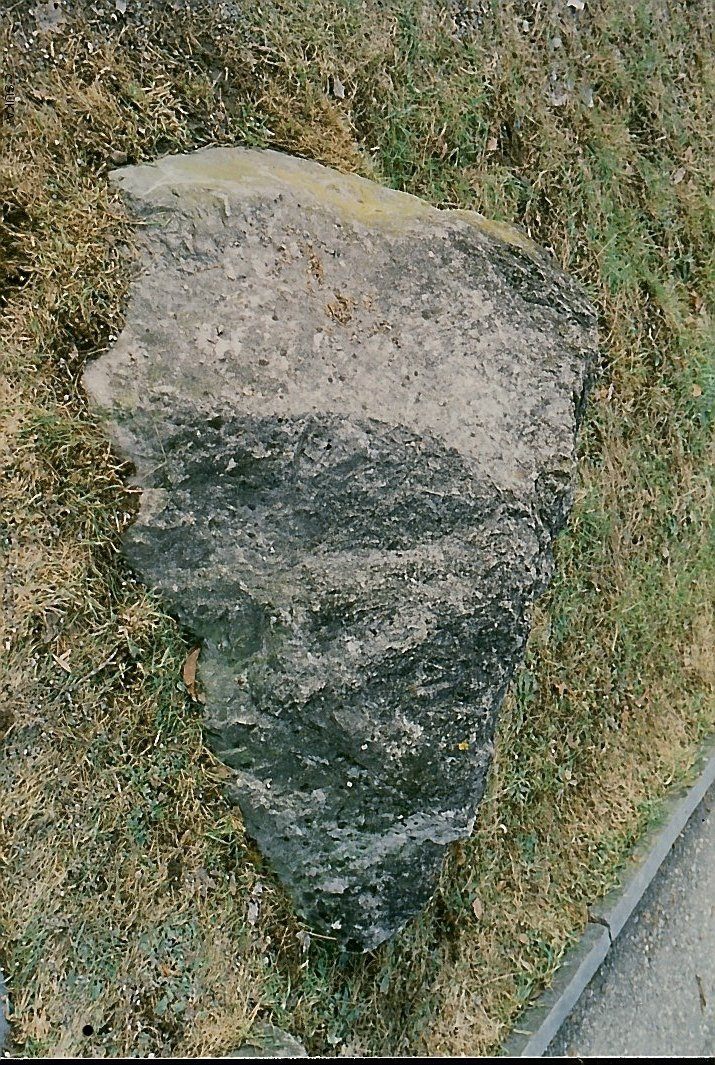
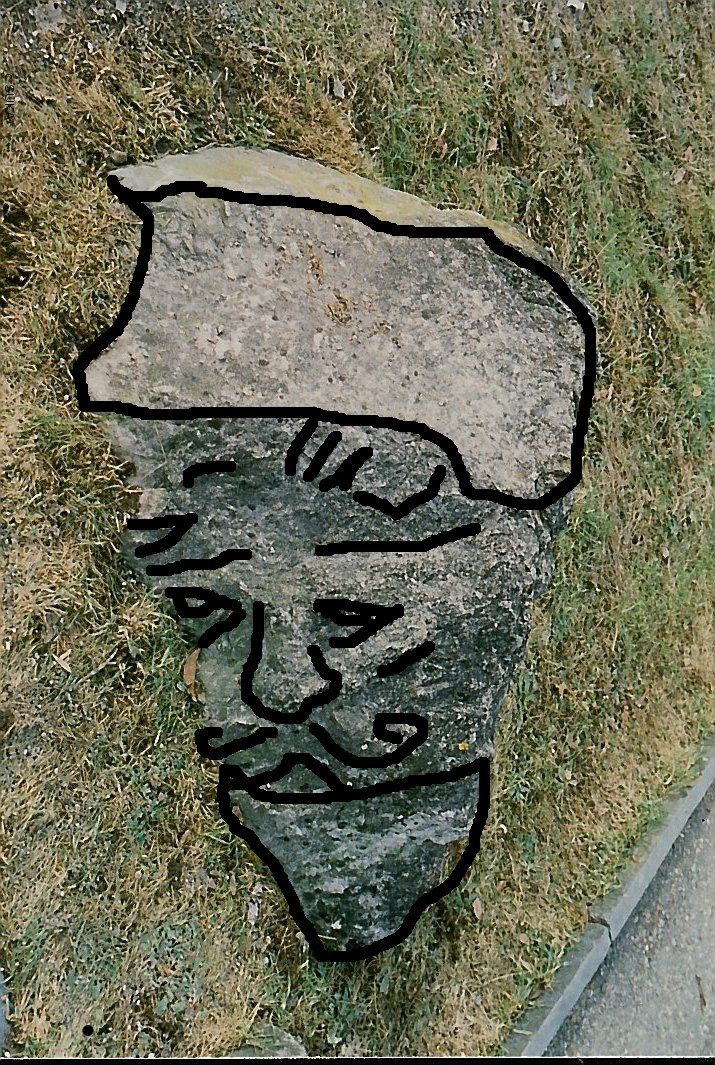
He is about 7,000 years old and has a moustache. The worked stone stands in front of the Hirzel company on Motorenstrasse and shows its face in the shadow after 2 p.m. when the sun is out.
The stone on Motorenstrasse.The face in the shadow, drawn on.